Alabama residents spent an estimated $30 million on OnlyFans in 2025, ranking the state 47th in the nation on a per-capita basis, according to estimates published by OnlyGuider, a search engine and analytics company that tracks the subscription platform best known for adult content.
The company’s “OnlyFans Wrapped 2025” report, which has been republished by television stations and news aggregators across the country in recent months, ranks all 50 states, dozens of cities, and thousands of counties by estimated spending. Alabama’s per-capita figure of $58,335 per 10,000 residents fell below the national average of $77,334. Americans overall spent an estimated $2.63 billion on the platform, according to the report.
Among Alabama cities, Birmingham ranked first, with an estimated $4.8 million in total spending and $244,494 per 10,000 residents, a figure the report ranks 13th among American cities. Mobile followed at $2.5 million, with Tuscaloosa, Huntsville, and Montgomery behind.
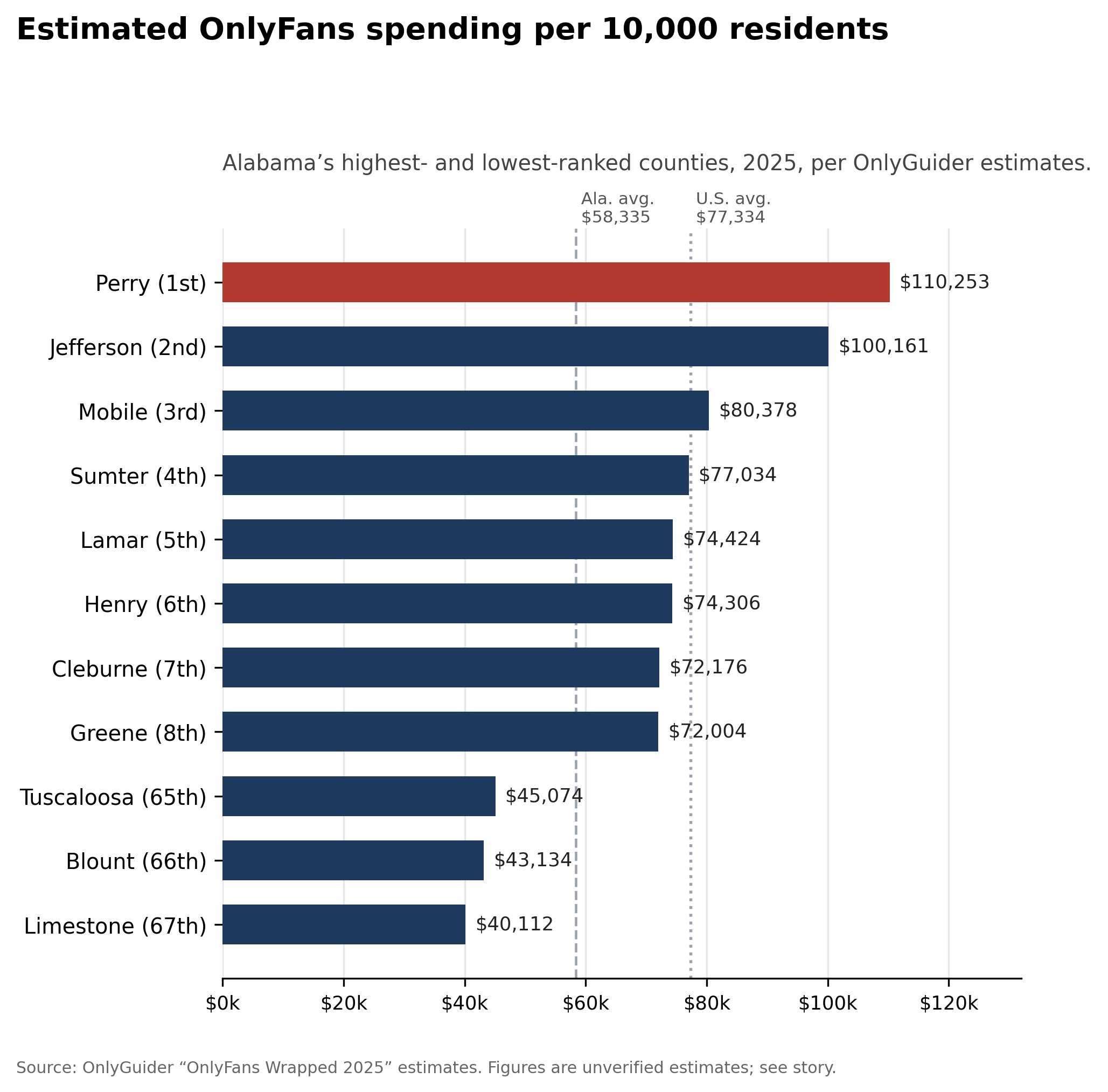
The county rankings produced less expected results. Perry County, with a population of about 7,800, ranked first in the state in per-capita spending at an estimated $110,253 per 10,000 residents, ahead of Jefferson County at $100,161. Sumter County ranked fourth, Greene County eighth, and Wilcox and Lowndes counties placed in the top half, giving the Black Belt several of the state’s highest per-capita estimates. Tuscaloosa County ranked 65th of 67.
OnlyFans itself does not release geographic spending data. OnlyGuider, which has a commercial interest in publicity about the platform, says its figures come from a proprietary model combining census data, platform revenue disclosures, regional pricing estimates, and user engagement modeling. None of that information can be independently verified.
The report’s own figures also raise questions. Dividing each county’s reported total spending by its reported per-capita rate implies the population used in the calculation. For Alabama’s large counties, the implied populations closely match census figures. Jefferson County’s figures imply a population of about 669,000 against an actual count of about 665,000, and Mobile County’s imply about 411,000 against an actual 414,000, with Madison, Montgomery, Tuscaloosa, and Baldwin counties showing similar agreement.
The figures for small counties do not appear to reconcile. The report’s Perry County numbers imply a population of about 15,600, roughly double the county’s actual size. Its Hale County numbers imply about 5,600 people in a county of about 14,700, and its Bullock County numbers imply about 2,200 residents in a county of about 10,000. The discrepancies run in both directions and follow no apparent pattern.