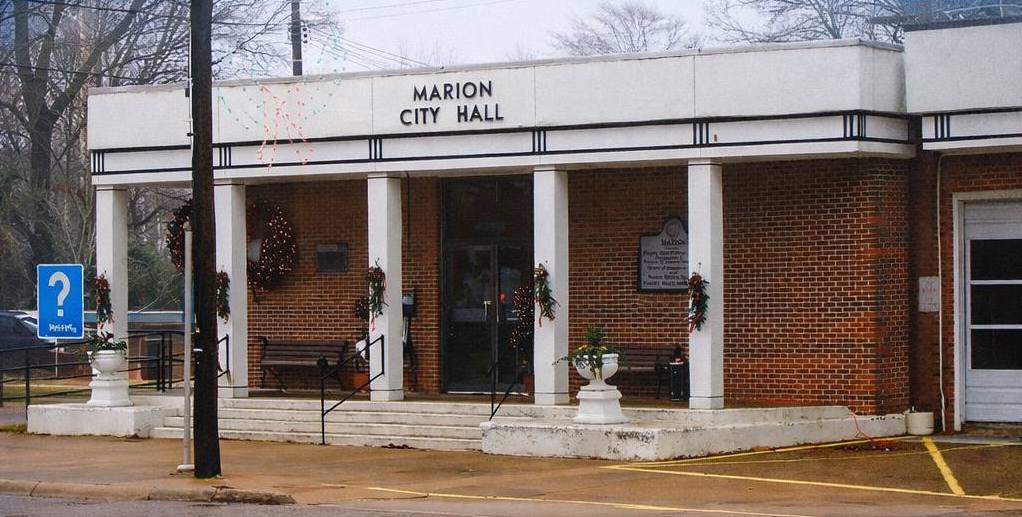
State demands years of financial records, citing $1.7 million in unaccounted utility payments
The Alabama Attorney General’s Office has launched a formal investigation into the municipal water and sewer system of the City of Marion, the Perry County seat and home to Marion Military Institute, under the state’s Deceptive Trade Practices Act, issuing a subpoena that demands years of financial records and targets what the state describes as approximately $1.7 million in utility payments the city cannot account for.The Subpoena Duces Tecum, signed March 25 by Brad A. Chynoweth, Assistant Chief Deputy of the Attorney General’s Civil Division, was received by the Marion City Clerk-Treasurer’s office on March 30. It orders the city to produce all responsive documents by 10:00 a.m. on April 30 at the Consumer Interest Division’s offices in Montgomery.
The investigation marks a significant escalation of state scrutiny of a small Black Belt municipality already facing regulatory warnings, failed audits, and unanswered questions about how public funds have been managed.
The state’s case
An addendum to the subpoena lays out the Attorney General’s basis for the investigation. The office states that it possesses “a good-faith basis to investigate whether the systemic failure to account for these consumer payments, or the unauthorized diversion thereof, constitutes unconscionable, false, misleading, or deceptive acts or practices” in violation of Alabama Code § 8-19-5(27).
At the center of the inquiry is a straightforward question: what happened to roughly $1.7 million that Marion residents paid for water and sewer service during Fiscal Years 2022 and 2023?
The state’s concern stems in part from the fact that independent financial audits for those two fiscal years, conducted by the firm Banks, Finley, White & Co., could not be certified. The city’s accounting records were too incomplete for auditors to verify. With the audits effectively failed, the Attorney General is now requiring production of the raw financial documents, including general ledgers, bank statements, and inter-fund transfer records, to trace where consumer payments went.
The scope of the investigation extends beyond the $1.7 million. The addendum states that the inquiry “expressly encompasses any additional violations of the DTPA arising out of, relating to, or uncovered during the course of this investigation into the City’s operation of its municipal enterprise funds.”
A sweeping document demand
The subpoena’s document requests are extensive, covering records from October 1, 2021, to the present and spanning four broad categories.
The state is seeking all city ordinances, budgets, council minutes, organizational charts, and correspondence with state and federal regulatory agencies including the Alabama Department of Environmental Management, the EPA, and the Alabama Department of Examiners of Public Accounts.
Financial requests include every adopted budget for the Water Utility Fund and General Fund from FY2022 through FY2026, all required annual audits, communications with the city’s outside auditors, unadjusted general ledgers, and complete banking records for every municipal account.
The water system requests encompass service maps, meter inventories, billing cycle data, customer accounts receivable, rate calculations, employee records, water quality reports, ADEM monthly filings, and all customer complaints and the city’s responses.
A separate section targets specific transactions that have drawn scrutiny. Among them: approximately $170,000 in ADEM grant funds and their disposition; emergency lines of credit or loans sought by the city in late 2025, including a $50,000 request for audit funding and a $100,000 request for payroll; the receipt and disbursement of approximately $179,000 from Alabama Power; IRS Form 941 filings and correspondence regarding past-due payroll taxes; an approximate $15,000 unpaid balance to a fuel supplier; and financial disclosures or insolvency affidavits related to a $12,000 civil penalty for illegal dumping.
Jurisdiction under the DTPA
The Attorney General’s addendum addresses a legal question central to the investigation: whether a municipal utility can be subject to the Deceptive Trade Practices Act.
The office concludes that it can. Marion’s water and sewer customers are “consumers” purchasing goods and services for household use under Alabama Code § 8-19-3(4). The city, operating a municipal enterprise fund and billing for utility services, constitutes a “person” engaged in trade or commerce under § 8-19-3(10).
Alabama law does provide a narrow DTPA exemption for utilities regulated by the Alabama Public Service Commission. But because Marion’s water system operates independently and is not subject to PSC jurisdiction or rate-making authority, the Attorney General’s office concludes that the exemption does not apply. The city’s water system, the addendum states, “is expressly excluded from this safe harbor and remains fully subject to the consumer protection and investigatory enforcement provisions of the DTPA.”
That jurisdictional finding could carry implications beyond Marion. Many Alabama municipalities operate water and sewer systems outside PSC oversight. The Attorney General’s assertion that those systems fall under the DTPA’s consumer protection framework establishes a precedent that could apply to any similarly situated municipal utility in the state.
City seeks delay
The city responded one day after receiving the subpoena. In a March 31 letter signed by City Clerk-Treasurer Laura Williams-Hinton, the city acknowledged receipt and stated it is “committed to cooperating fully and in good faith.”
The letter then requested a 60 to 90 day extension to respond, citing “limited administrative capacity, including recent staff transitions and ongoing restructuring within key operational areas.” Williams-Hinton wrote that producing all requested materials on the original timeline “presents a significant logistical challenge and may substantially impact the City’s ability to maintain essential day-to-day governmental operations.”
The city also proposed a phased production schedule, requested clarification on certain items involving third-party records, and asked the Attorney General to consider alternatives such as on-site document review.
The letter was copied to City Attorney Hank Sanders, Ainka Sanders Jackson, Mayor Dexter Hinton, and all five members of the Marion City Council.
A city under pressure
The investigation arrives at a moment of compounding crises for the Perry County seat.
The city’s FY2022 and FY2023 financial audits could not be certified. The Alabama Department of Environmental Management warned in March that $2,475,000 in American Rescue Plan Act funding for Marion’s water infrastructure could be clawed back if the city fails to demonstrate progress by an April 10 deadline. The city faces an unresolved IRS payroll tax assessment. And local reporting by the Times-Standard-Herald has documented a pattern of financial irregularities, including nearly $466,000 in state and federal grant funds arriving at City Hall in a single day in November 2025 while vendors, including the supplier of water treatment chemicals, reported unpaid invoices.
The city has also drawn scrutiny for its handling of public records. The Times-Standard-Herald has had open records requests pending since December 2025. In March 2026, the city council considered adopting a public records resolution that would impose requirements not found in state law, including a provision requiring requesters to state their purpose, a condition that conflicts with the Alabama Open Records Act as amended by Act 2024-278. The Attorney General’s subpoena now demands many of the same categories of records the city has not produced in response to those requests.
At the same time, the State of Alabama has made significant investments in Perry County’s future. The state, county, and city have provided tax incentives in connection with a proposed pharmaceutical manufacturing facility, Congress has appropriated $400,000 for improvements at Vaiden Field Airport, and the state has funded a $35 million math and science building at Marion Military Institute. Those investments depend on functioning municipal infrastructure, the very infrastructure now at the center of the Attorney General’s investigation.
This is a developing story. The Alabama Beacon will publish updates as additional information becomes available.