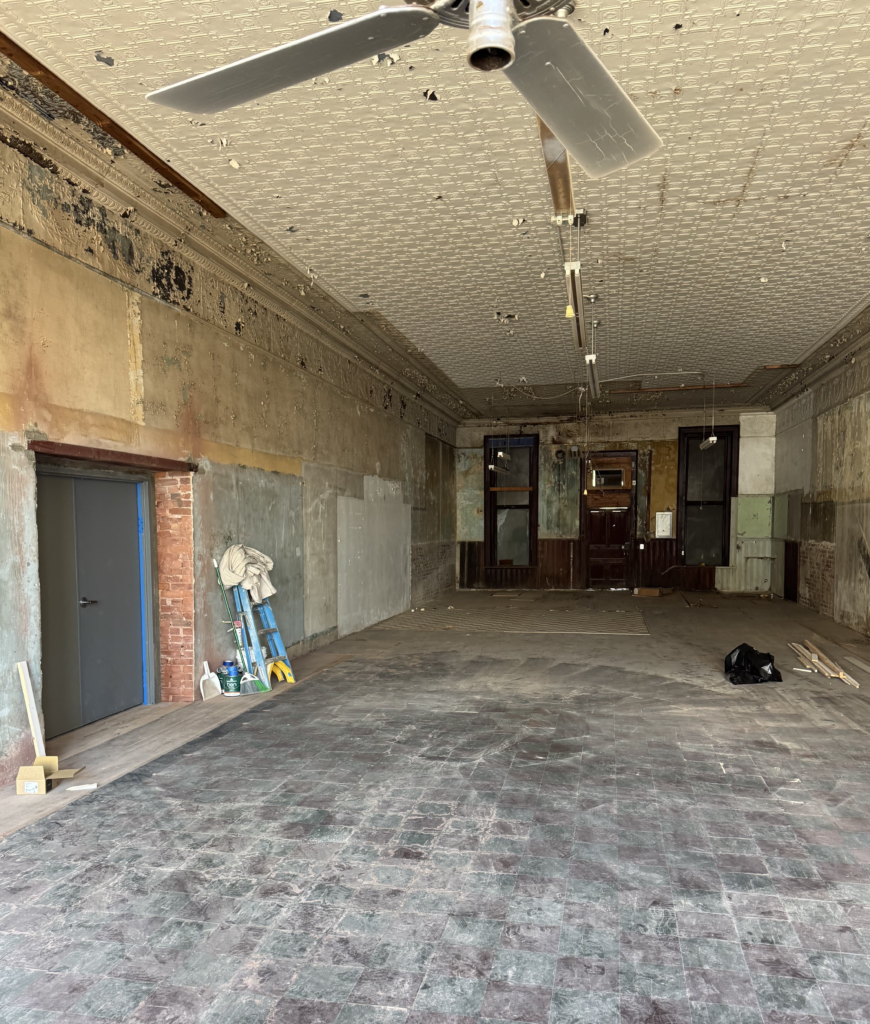
Workers opened a passage through the two-foot-thick brick wall that had separated the Opera House from its west-side space, known locally as Phillips II, since 1903.(above)
Farcical history closes the storytelling season Sept. 13, as building marks a first since 1903
The Phantom is coming back. The Greensboro Opera House will present “Thrice-Told Tales: The Phantom of the Greensboro Opera House,” a farcical history of the Opera House and other local stories, on Sunday, Sept. 13, at 6 p.m. Admission is $10, and students are admitted free.
The locally written, produced and performed play is the third and final event of the Opera House’s 2026 drama season, “Twice-Told Tales,” a celebration of the tradition of storytelling made possible in part by a grant from the Alabama State Council on the Arts. It brings back the title character of “The Phantom of the Greensboro Opera House,” the comedy staged at the Opera House in 2024, in the same comic spirit.
The season opened in April with “Fireball,” Hale County native Norman McMillan’s one-actor play about Tennessee plow girl Hazel Lindsey, and continued in August with a weekend storytelling workshop and public performance led by professional storyteller Dolores Hydock.
The building whose history the Phantom sends up has, meanwhile, added a real chapter of its own. The Opera House has reached a milestone in the restoration of its historic downtown home: for the first time since the building was constructed in 1903, all three of its original first-floor commercial spaces are connected.
The project, also made possible in part through a grant from the Alabama State Council on the Arts, connected the western portion of the building, known locally as Phillips II, to the main Opera House.
When the building went up in 1903, it consisted of three separate commercial spaces divided by substantial brick walls. Over the years the two eastern portions were joined, while the west side remained cut off from the rest of the first floor. That side was most recently used as a law office and still held cubicles, store fixtures, furnishings and other remnants of the businesses that occupied it over the years, all of which had to be cleared before work could begin.
The most dramatic moment came when workers cut an opening through the roughly two-foot-thick brick wall separating the west side from the Opera House, removing a division that had stood for more than 120 years.
The additional space opens possibilities for improved guest circulation and gathering space, storage for stage and event equipment, dressing areas, additional restrooms and future accessibility improvements as the Opera House continues to grow as a center for concerts, plays, storytelling programs, lectures, art exhibitions and community events.
Trim, painting and other minor finishing work remain, but the major objective is accomplished: visitors can now walk directly from the Opera House into a portion of the building that had remained separate throughout its 123-year history.
The Opera House credited the Alabama State Council on the Arts along with the contractors, volunteers, board members and community supporters whose work made the project possible.