Everyone knows the story. People who have never watched a single baseball game know the story. Babe Ruth lumbers to the plate in Game 3 of the 1932 New York Yankees-Chicago Cubs World Series. He exchanges a few words with the pitcher and then points to the sky over the wooden outfield fence (it would be another five years before the now famous brick wall with its climbing ivy replaced that old wooden fence).
He called his shot. He told the pitcher via hand gesture where he was going to send the next ball that came his way. Some baseball historians have argued over the years that the Great Bambino was making a different sort of hand gesture, one that used the second finger and was meant solely for the pitcher, Charlie Root. That would have been in keeping with the general mood of this particular Series, which had been raucous.
But most people still believe Babe Ruth was pointing out where his next home run would go. And most people know that he did in fact put the next pitch over the center-field wall; it was one of two home runs he would hit during the 4-game series-sweep of the Cubs.
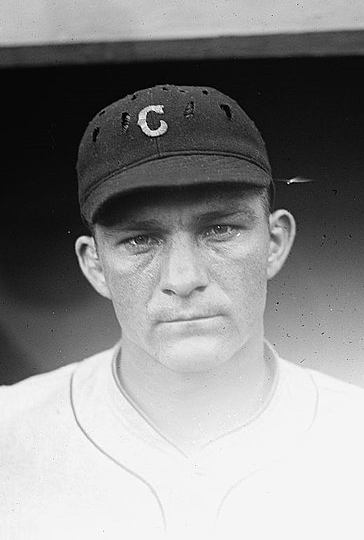
Most people don’t know that the left fielder that day for the Cubs was a man named Riggs Stephenson, from the town of Akron in Hale County, Alabama. And Riggs had a higher batting average for that World Series than Babe Ruth. As a matter of fact, he had the highest batting average of the entire Cubs organization for that Series.
Today, he is virtually unknown.
Riggs Stephenson was born in Akron in 1898. He played baseball, basketball, and football at the University of Alabama. A vicious tackle in a 1920 game for the Tide injured his shoulder to the extent that it ended his football career. The injury would also plague him for the entirety of his baseball career. He didn’t have a good throwing arm anymore.
But he could still hit the baseball.
Stephenson quit school and signed with the Cleveland Indians in 1921. He started at second base on Opening Day and hit 14 for 25 in his first seven games. And though he was worried about his throwing arm, he only committed one error in his first 18 games. He committed 14 errors in his next 30 games and was benched by future Hall of Fame player and manager Tris Speaker.
Stephenson came back in 1922 and made 21 starts at second base and 29 at third. The Sporting News said of him:
“Stephenson has one of the best batting eyes that has come into this league in many seasons. He can do everything but make snap throws.”
Still, he managed a .339 batting average and slugged .511 with runners in scoring position. Tris Speaker didn’t know what to do with Stephenson. Connie Mack, the legendary player turned owner-manager of the Philadelphia A’s, suggested that Speaker should put Stephenson at first base, a position that required far less throwing than second or third.
Stephenson himself was all too aware of his fielding deficiencies. “I wasn’t such a good defensive player,” he said. “I had trouble making the double play on the pivot.”
Stephenson found himself benched for most of the first half of the 1923 season. And from his position on the pine he could clearly hear the rumors of his impending demotion to the minors or trade to a lesser team. But then a broken finger sidelined the regular second baseman and Stephenson was given another chance. He came through with a .329 batting average and 63 runs in just 277 at-bats for the duration of the season.
Looking more confident at the plate and in the field, Stephenson was batting .365 and had made only one error when he injured his leg in a basepath collision during a game against the White Sox on May 1st in 1924. Stephenson spent a month on the Disabled List but came back with a savage eleven-game stretch in August in which he went 25 for 44 at the plate and knocked in 17 runs with a .371 average at the end of the season.
It wasn’t enough. Stephenson was sent down to the Kansas City Blues in the Double-A association in 1925. After two months he was sent to the Indianapolis Indians. He was still in Indianapolis at the start of the 1926 season. He was still hitting. Nobody ever said he couldn’t hit. He had a .385 average after the first 50 games of the season.
An opportunity for redemption came in June, when the Chicago Cubs traded an outfielder and an infielder to the Indianapolis club in exchange for Stephenson and utility player Hank Schreiber. Stephenson was put in left field. He considered himself lucky.
“My arm wasn’t strong enough to play right field,” he said. “You gotta have the best arm on the team in right field. I was lucky to get to Chicago. They needed a left fielder.”
Despite a late-season back injury, Stephenson led the Cubs with a .338 average. In 1927 he batted fifth behind teammate Hack Wilson, the National League’s home run leader. The placement worked to the Cubs’ benefit, as no pitcher wanted to walk Wilson just to put a runner on base for Stephenson to drive in. Closing out the year with a .344 batting average (4th highest in the National League) the baseball player from Hale County had reason to be optimistic.
That’s usually when the rug makes a lateral transition from its position under your feet. But it didn’t happen to Stephenson; it happened to his team. The Cubs couldn’t put together enough wins for the first half of the season. A late season run improved their position in the standings, but it was too little, too late.
I suppose in 1927 people were still surprised when the Cubs didn’t make the playoffs. Regardless, Stephenson had the team-high batting average once again at .324. Sportswriters knew Stephenson was vastly underrated. Henry L. Farrell wrote, “Stephenson is one of the immensely valuable players who doesn’t command the spotlight. The Chicago fans know how valuable he is, but the customers in other cities know more about Gabby Hartnett, Hack Wilson, and others.”
Cubs reporter Edward Burns said, ”He is the Cubs most vicious batsman and mildest citizen.” Other writers referenced his collegiate background at UA, his gentlemanly Southern conduct, and his status as a teetotaler. In Prohibition Chicago, Stephenson was one of very few players who didn’t seek out speakeasies after games were over.
The Cubs acquired power-hitter Rogers Hornsby from the Boston Braves in the off-season and looked to be contenders for the NL pennant in 1928. It seemed to be a lock. Cuyler, Hornsby, Wilson, and Stephenson combined for a staggering 520 RBI’s, 493 runs, and a joint .362 batting average. Stephenson knocked in a career-high 110 runs.
But Stephenson, already accustomed to pain from his shoulder injury for UA, had to contend with more after a knee injury in early June. He ruptured an abdominal muscle in late August. He played through the pain to finish his best season with a .362 BA and 17 home runs.
A shoulder injury suffered during spring training in 1930 limited Stephenson to only 79 starts in left field and some sporadic pinch-hitting. The Cubs played good ball for most of the season but unraveled in late August. That would become a theme for the Cubs over the next 86 years. Yet Stephenson, now plagued by injuries, still batted a team-high .367 for the year.
Prior to spring training in 1931, Chicago sportswriters printed rumors that Johnny Moore from the Pacific Coast League would be replacing Stephenson. But the Alabaman kept producing hits until a season-ending injury in July. Stephenson collided with Phillies pitcher Sheriff Blake at first base and rolled his ankle on the bag, breaking the bone and tearing muscle. He was batting .319 at the time.
Now the Chicago press really called it a day on Stephenson. Paul Michaelson wrote, “He cannot be counted on to play regularly so a replacement is necessary.”
But, as he had done so many times before, Riggs Stephenson made a seemingly miraculous recovery and played his heart out. The oldest starting position player on the team at 34, Stephenson led the Cubs in batting (.324) RBI’s (85) and doubles (49).
The Cubs were no match for the Yankees in the 1932 World Series. They were swept in four games, with Game 3 becoming internationally known as Babe Ruth’s called-shot game. But Stephenson’s .444 batting average was team-best and higher than Ruth’s .333. In fact, only Lou Gehrig of the Yankees hit better with an amazing .529 batting average.
Stephenson kept playing for the Cubs in 1933 and 1934 but he was out of miraculous recoveries. He could still hit better than most, but his multiple injuries had finally slowed him down. Stephenson finished his major league career with a .336 lifetime batting average; that number still holds today as the 22nd highest career average.
His .336 lifetime average is also the highest in Chicago Cubs history.
In 1936 he accepted the Cubs’ offer to serve as player-manager for the team’s new affiliate in the Class 1A Southern Association: the Birmingham Barons. He led the Barons in hitting (.355 over 120 games) and managed them to a league title over the New Orleans Pelicans.
Stephenson managed the Montgomery Rebels for half a season in 1939 before retiring. He moved back to Akron and lived with Alma Chadwick, whom he had married in 1934, and the couple had two children, Jack and Marla. Stephenson farmed and ran a lumber mill in Akron before opening a car dealership (Riggs Chrysler Plymouth) in Tuscaloosa.
Riggs was inducted into the Alabama Sports Hall of Fame in 1971. He died on November 15, 1985, at the age of 87. He is buried at Tuscaloosa Memorial Park.